
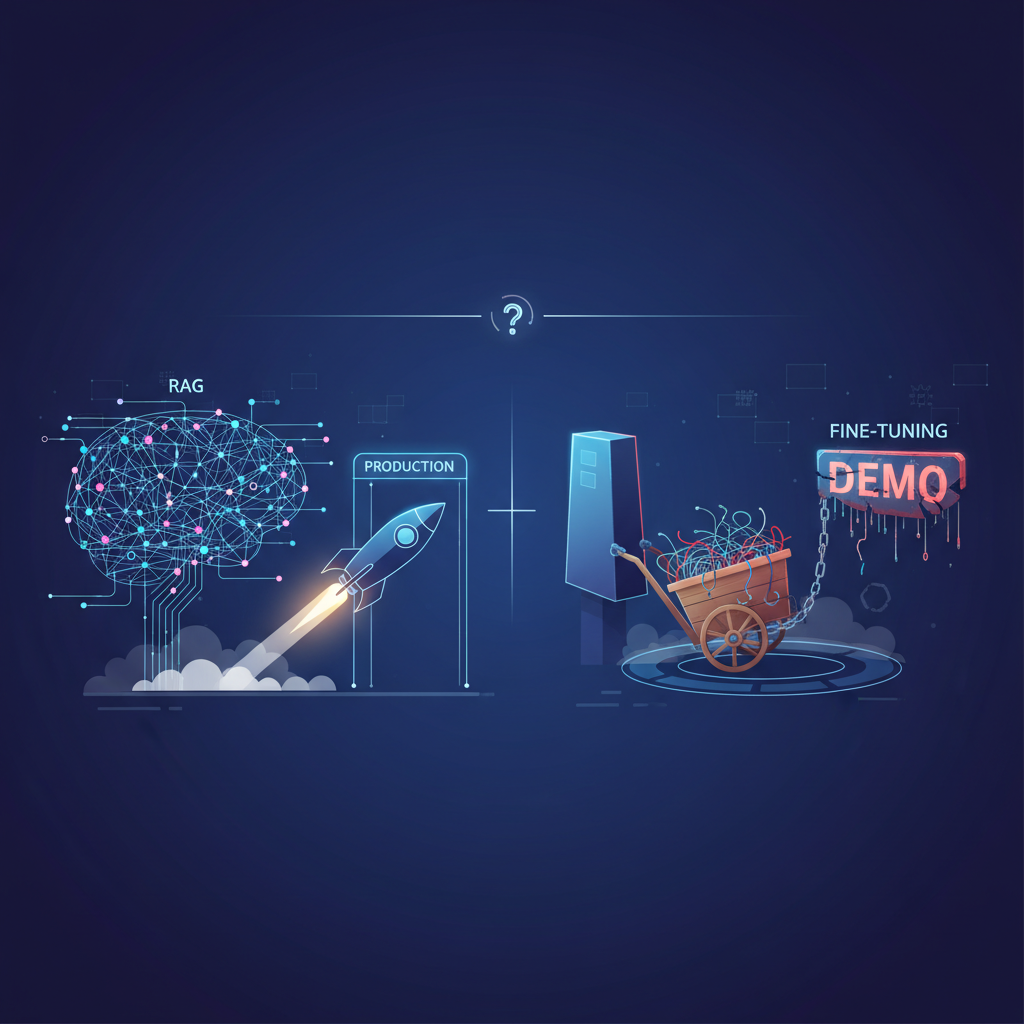
RAG vs Fine-Tuning: The AI Decision That Determines Whether Your Project Ships or Stays in Demo Forever
You have built a promising AI prototype. The demo looks great, stakeholders are excited, and everyone is ready to move forward. Then comes the moment of truth: taking it to production. Suddenly, the model hallucinates facts, gives outdated answers, or simply cannot handle your company's proprietary data. The project stalls. Sound familiar?
The root cause of most failed AI deployments comes down to a single architectural decision made too early — or made without fully understanding the tradeoffs. That decision is choosing between Retrieval-Augmented Generation (RAG) and Fine-Tuning. Get it right, and your project ships. Get it wrong, and it lives in demo purgatory forever.
At WB Studio's AI Solutions team, we help businesses navigate exactly this decision every day. This guide breaks down everything you need to know to choose the right path for your specific use case.
Understanding the Core Problem
Large language models (LLMs) like GPT-4, Claude, or LLaMA are trained on massive datasets up to a certain knowledge cutoff date. They are incredibly powerful at reasoning, summarizing, and generating language — but they have two critical limitations:
- They don't know your data. Your internal documents, customer histories, proprietary knowledge bases, or real-time information simply do not exist inside a pre-trained model.
- They hallucinate. When a model doesn't know something, it often invents a plausible-sounding answer rather than admitting ignorance.
Both RAG and fine-tuning exist to solve these problems, but they do so in fundamentally different ways, with very different costs, timelines, maintenance burdens, and production risks.
What Is Retrieval-Augmented Generation (RAG)?
RAG is an architectural pattern that keeps the base model unchanged but dynamically feeds it relevant information at inference time. When a user submits a query, the system:
- Converts the query into a vector embedding.
- Searches a vector database for the most relevant document chunks.
- Injects those chunks into the model's context window as part of the prompt.
- Generates a response grounded in that retrieved context.
In practical terms, think of RAG as giving your AI model a search engine and a library card. It doesn't need to memorize everything — it just needs to know where to look.
Key Advantages of RAG
- Up-to-date information: Update your knowledge base without retraining the model. Perfect for dynamic environments.
- Source attribution: You can show users exactly which document the answer came from, dramatically reducing hallucination risk.
- Faster time to production: A basic RAG pipeline can go from zero to production in days or weeks, not months.
- Lower cost: No GPU clusters, no training runs, no data labeling at scale.
- Auditability and compliance: In regulated industries, being able to trace every answer back to a source document is invaluable.
When RAG Struggles
- When the model needs to behave very differently from its base training — adopting a completely new tone, domain logic, or reasoning style.
- When latency is critical and you cannot afford the retrieval step.
- When the knowledge required is highly structured and relational in ways that simple document retrieval does not capture well.
What Is Fine-Tuning?
Fine-tuning means taking a pre-trained model and continuing its training on a curated dataset specific to your use case. You are literally changing the weights of the neural network to make the model better at a specific task or domain.
Think of it as sending a highly educated generalist back to specialized school. After fine-tuning, the model internalizes patterns, styles, terminology, and behaviors that you define through your training data.
Key Advantages of Fine-Tuning
- Behavioral customization: The model learns to reason, respond, and format answers in ways that align with your brand or domain logic.
- No retrieval dependency: For tasks where the knowledge is static and bounded, fine-tuned models can be faster and leaner.
- Better performance on specialized tasks: Medical coding, legal clause analysis, or code generation in proprietary languages can all benefit enormously from fine-tuning.
- Smaller models, bigger results: A fine-tuned 7B parameter model can outperform a generic 70B model on a narrow task, reducing costs significantly.
When Fine-Tuning Fails in Production
- Data drift: Your business data changes. The fine-tuned model doesn't. You now have an expensive, outdated model that requires retraining cycles.
- Catastrophic forgetting: The model can lose general capabilities as it specializes, creating unexpected failures outside the training distribution.
- High upfront investment: You need high-quality labeled data, compute resources, evaluation pipelines, and ML engineering expertise.
- Long feedback loops: A training run might take days. Discovering a problem means going back to the drawing board.
The Production Reality: Why Most Projects Get This Wrong
The most common mistake we see is teams defaulting to fine-tuning because it sounds more sophisticated. Fine-tuning feels like "real AI work" — training data, GPU hours, model versions. RAG, by contrast, feels like "just prompt engineering."
This intuition is backwards. In production environments, simplicity and maintainability win. A RAG system with a well-maintained knowledge base and good retrieval logic will outperform a fine-tuned model on most enterprise use cases — and it will be dramatically easier to update, debug, and improve over time.
Our team at WB Studio AI consistently finds that enterprises that start with RAG ship faster, iterate more confidently, and achieve better business outcomes than those who invest months in fine-tuning pipelines before validating their core assumptions.
A Practical Decision Framework
Use this framework to determine which approach fits your project:
Choose RAG If:
- Your knowledge base changes frequently (product catalogs, policies, legal documents, market data).
- You need source citations or explainability for compliance or trust reasons.
- You want to go to production quickly and iterate based on real user feedback.
- Your primary problem is the model not knowing your data, not behaving incorrectly.
- You have a limited ML engineering budget or team.
Choose Fine-Tuning If:
- The model needs to adopt a very specific style, format, or reasoning pattern consistently.
- You have a bounded, stable domain where knowledge does not change often.
- You need to reduce inference costs at very high scale using a smaller specialized model.
- Your task involves structured output generation that generic models handle poorly.
- You have a high-quality labeled dataset already available or the budget to create one.
Consider Combining Both If:
In some advanced production scenarios, the right answer is actually a hybrid: fine-tune a model to adopt the right reasoning style and output format, then layer RAG on top for dynamic knowledge retrieval. This approach is more complex but can deliver superior results for high-stakes applications like enterprise copilots or specialized customer service agents.
Real-World Use Cases: Matching the Right Tool to the Job
Legal Document Analysis
A law firm wants an AI assistant that can answer questions about case law and internal precedents. RAG wins here. Legal knowledge changes constantly, source citation is non-negotiable, and the document corpus is too large for any context window. The firm can update its knowledge base as new rulings come in without touching the model.
Customer Support Chatbot
An e-commerce company wants a chatbot that handles returns, tracks orders, and answers product questions. RAG wins again. Product information changes daily, and the bot needs to pull live order data from APIs. Fine-tuning would create a static system incapable of reflecting real-time inventory or policy changes.
Medical Coding Assistant
A healthcare provider wants an AI to suggest ICD-10 billing codes from clinical notes. Fine-tuning is a strong candidate here. The coding system is stable, the task is highly structured, and accuracy at scale justifies the training investment. A smaller fine-tuned model can run with lower latency and cost than prompting a large general model.
Internal HR Policy Bot
A large corporation wants employees to query HR policies, benefits, and procedures. RAG is the clear winner. HR documents are updated regularly, employees need to trust the source, and the project needs to launch quickly without waiting for training pipelines.
The Cost Equation Nobody Talks About
When evaluating these options, most teams focus on initial build cost. This is a mistake. The more important metric is total cost of ownership over 12–24 months.
Fine-tuning a model might cost $50,000–$500,000 in compute, data preparation, and engineering time upfront. But when your business requirements change — and they always do — you face retraining costs, re-evaluation cycles, and deployment downtime all over again.
A well-architected RAG system, by contrast, has a lower initial build cost and a much flatter ongoing maintenance curve. Update the knowledge base, test retrieval quality, redeploy. That's it.
If you're looking to make this decision with expert guidance tailored to your specific industry and technical constraints, our teams are ready to help. Explore our AI solutions in English, our soluciones de inteligencia artificial en español, or our soluzioni di intelligenza artificiale in italiano.
Common Pitfalls to Avoid Regardless of Your Choice
- Skipping evaluation: Whether you use RAG or fine-tuning, you need a robust evaluation pipeline with real-world test cases before deploying to production.
- Ignoring retrieval quality in RAG: A RAG system is only as good as its retrieval layer. Poor chunking strategies, bad embeddings, or no reranking step will ruin even the best model.
- Under-investing in data quality for fine-tuning: Garbage in, garbage out. Fine-tuning on noisy or inconsistently labeled data produces an unreliable model that will embarrass your organization in production.
- Building for the demo, not for the user: Both approaches can be optimized to look great in a controlled demo. Production is different. Test with messy, real-world inputs from day one.
- Locking in too early: Start with the simpler architecture, validate your core assumptions, then upgrade complexity only when the business case demands it.
The Strategic Bottom Line
The RAG vs fine-tuning debate is not a technical question. It is a product strategy question. The right answer depends on your timeline, your data reality, your compliance requirements, your team's capabilities, and your tolerance for maintenance complexity.
What we know with certainty from working with dozens of enterprise AI projects is this: the teams that ship are the teams that start simple, validate fast, and scale deliberately. RAG gets most projects across the finish line faster than fine-tuning. Fine-tuning creates a competitive moat when applied to the right narrow problem with the right data discipline.
Don't let architectural indecision be the reason your AI project never leaves the demo environment. Make the decision deliberately, instrument it well, and build with production in mind from day one.
Whether you're evaluating AI for the first time or looking to upgrade a struggling implementation, the WB Studio team offers deep technical expertise and production-proven methodologies. Discover how we approach these decisions through our artificial intelligence solutions page, available in Spanish and Italian as well.
Final Thoughts
The best AI architecture is the one that ships, scales, and survives contact with real users. Stop optimizing for impressiveness in the demo room. Start optimizing for resilience, maintainability, and alignment with actual business needs in production environments.
RAG is not the easy option. Fine-tuning is not the sophisticated option. They are simply different tools for different jobs. Master the decision framework, match the tool to the problem, and your AI project will move from demo to deployment — and stay there.