NIS2 vs ISO 27001: Key Differences and What Your Business Really Needs
In today's rapidly evolving cybersecurity landscape, businesses across Europe and beyond are facing increasing pressure to comply with regulatory frameworks and international standards. Two terms that frequently come up in this context are NIS2 and ISO 27001. While both aim to strengthen information security and cyber resilience, they are fundamentally different in nature, scope, and application. Understanding these differences is crucial for any organization trying to navigate compliance requirements effectively.
This article breaks down the key distinctions between NIS2 and ISO 27001, explains what each one requires, and helps you determine what your business truly needs to stay secure and compliant.
What Is NIS2?
NIS2 (Network and Information Systems Directive 2) is a European Union regulatory directive that entered into force in January 2023 and was required to be transposed into national law by EU member states by October 2024. It is an evolution of the original NIS Directive (2016) and significantly expands the scope of cybersecurity obligations for organizations operating within the EU.
NIS2 applies to a broad range of sectors, including energy, transport, banking, healthcare, digital infrastructure, and many more. It distinguishes between two categories of entities:
- Essential Entities: Large organizations in critical sectors such as energy, water, transport, and healthcare.
- Important Entities: Medium and large organizations in additional sectors like postal services, food production, manufacturing, and digital providers.
NIS2 mandates specific security measures, incident reporting obligations, supply chain security requirements, and significant penalties for non-compliance — including fines of up to €10 million or 2% of total global annual turnover for essential entities.
If your organization falls within the scope of NIS2, compliance is not optional. It is a legal obligation. To understand if your business is affected and how to approach compliance, you can explore our dedicated NIS2 compliance solutions page.
What Is ISO 27001?
ISO 27001 is an international standard published by the International Organization for Standardization (ISO) and the International Electrotechnical Commission (IEC). It provides a framework for establishing, implementing, maintaining, and continually improving an Information Security Management System (ISMS).
Unlike NIS2, ISO 27001 is voluntary. Organizations choose to adopt it to demonstrate their commitment to information security best practices and to build trust with clients, partners, and stakeholders. Certification is granted by accredited third-party certification bodies after a formal audit process.
ISO 27001 is applicable to organizations of any size, in any sector, anywhere in the world. Its structured approach covers people, processes, and technology, making it one of the most comprehensive and globally recognized cybersecurity standards available.
NIS2 vs ISO 27001: The Key Differences
1. Legal Obligation vs Voluntary Standard
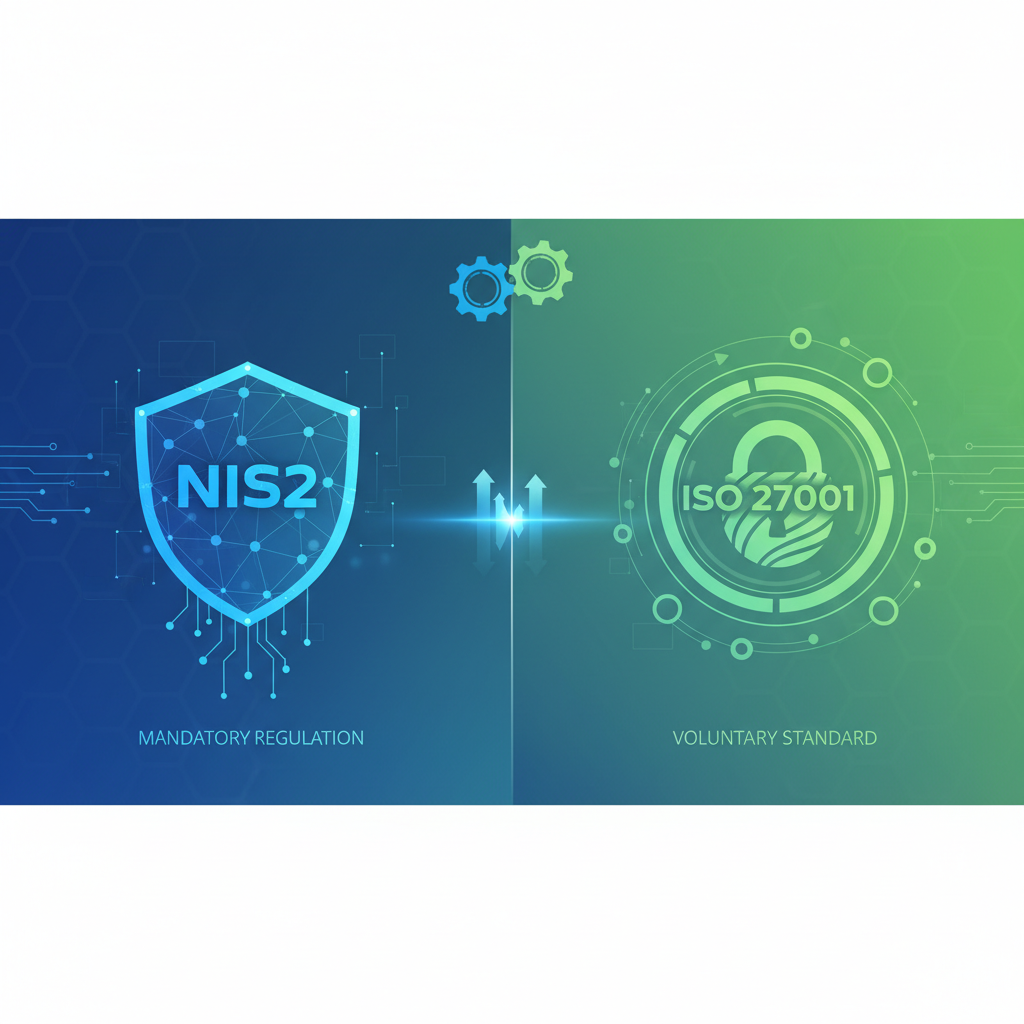
The most fundamental difference is their legal nature. NIS2 is mandatory for in-scope organizations within the EU. Failure to comply can result in severe financial penalties and reputational damage. ISO 27001, on the other hand, is voluntary. While it is highly recommended and often required by contracts or procurement processes, there is no regulatory body that will fine you for not having it.
2. Scope and Applicability
NIS2 has a defined geographic and sectoral scope. It applies to medium and large entities operating in specific sectors within the European Union. ISO 27001 has a universal scope — any organization, regardless of size, sector, or location, can pursue and achieve certification.
3. Prescriptive Requirements vs Flexible Framework
NIS2 is relatively prescriptive in its requirements. It specifies concrete measures that organizations must implement, such as:
- Risk analysis and information system security policies
- Incident handling and reporting (within 24 hours for early warnings)
- Business continuity and crisis management
- Supply chain security
- Use of cryptography and encryption
- Multi-factor authentication
ISO 27001 provides a flexible, risk-based framework. Organizations assess their own risks and choose appropriate controls from Annex A (which contains 93 controls in the 2022 version). This flexibility allows businesses to tailor their security posture to their specific context and threat landscape.
4. Enforcement and Certification
NIS2 compliance is enforced by national competent authorities within each EU member state. These authorities have the power to conduct audits, request information, issue binding instructions, and impose administrative fines. There is no formal "NIS2 certificate" — compliance is assessed and enforced by regulators.
ISO 27001 certification is obtained through a third-party audit conducted by an accredited certification body. Organizations receive a certificate valid for three years (subject to annual surveillance audits), which they can use to demonstrate their security credentials to clients and partners.
5. Focus and Objectives
NIS2 focuses primarily on cyber resilience at a national and cross-border level. It aims to protect critical infrastructure and essential services from cyberattacks that could have societal or economic impacts. ISO 27001 focuses on organizational information security management, helping businesses protect their own data and systems in a structured, systematic way.
Do NIS2 and ISO 27001 Overlap?
Yes — and significantly so. Many of the security controls and practices required by NIS2 align closely with the controls outlined in ISO 27001. This means that organizations with ISO 27001 certification already have a strong foundation for NIS2 compliance. However, ISO 27001 certification alone does not automatically guarantee NIS2 compliance, as NIS2 includes specific obligations around incident reporting timelines, governance responsibilities, and supply chain risk management that go beyond what ISO 27001 requires.
Think of ISO 27001 as the structural backbone of your information security program, and NIS2 as the regulatory layer that adds specific mandatory obligations on top.
What Does Your Business Really Need?
Determining whether you need to focus on NIS2, ISO 27001, or both depends on several factors:
If You Are an EU-Based Organization in a Regulated Sector
Your first priority should be NIS2 compliance. Non-compliance carries legal and financial risks that no business can afford to ignore. Start by assessing whether your organization falls under the directive's scope, understand the specific requirements applicable to your sector, and implement the necessary technical and organizational measures. Our team at WBStudio can guide you through every step of this process — visit our NIS2 solutions page for more information.
If You Want to Build Long-Term Cyber Resilience
Consider pursuing ISO 27001 certification. Even if your organization is not subject to NIS2, ISO 27001 provides a world-class framework for managing information security risks. It signals maturity to clients, helps win contracts, and creates internal discipline around security governance.
If You Are Subject to Both
A combined approach makes the most sense. By implementing an ISO 27001-aligned ISMS as the foundation of your security program, you can efficiently address the majority of NIS2 requirements while also benefiting from international certification. This dual approach maximizes your return on security investment and reduces compliance fatigue.
Common Mistakes Businesses Make
- Assuming ISO 27001 covers NIS2 entirely: It doesn't. You still need to address NIS2-specific obligations around reporting, governance, and supply chain security.
- Ignoring NIS2 because the deadlines seem far off: Implementation takes time. Starting early gives you a significant advantage.
- Treating compliance as a one-time project: Both NIS2 and ISO 27001 require ongoing commitment, continuous improvement, and regular review.
- Underestimating the scope of NIS2: Many organizations don't realize they fall within the directive's expanded scope until it's too late.
How WBStudio Can Help
Navigating the intersection of regulatory compliance and international standards can be complex, but you don't have to do it alone. At WBStudio, we specialize in helping businesses understand their obligations under NIS2 and implement robust security frameworks that align with both regulatory requirements and international best practices.
Whether you're just starting your compliance journey or looking to optimize an existing security program, our experts provide tailored guidance, gap assessments, implementation support, and ongoing advisory services. Explore our dedicated NIS2 compliance service page to learn how we can support your organization.
Conclusion
Both NIS2 and ISO 27001 play important roles in the modern cybersecurity ecosystem, but they serve different purposes and carry different implications for your business. NIS2 is a legal requirement for many EU organizations, with enforceable obligations and significant penalties. ISO 27001 is a voluntary but highly valuable standard that provides a comprehensive framework for managing information security.
The smartest approach for most businesses is not to choose between them, but to leverage ISO 27001 as the foundation and use it to accelerate NIS2 compliance. By doing so, you not only meet your regulatory obligations but also build the kind of resilient, security-conscious organization that can thrive in today's threat landscape.
Don't wait until regulators come knocking. Take proactive steps today — and if you need expert guidance, our NIS2 compliance team at WBStudio is ready to help you every step of the way.