
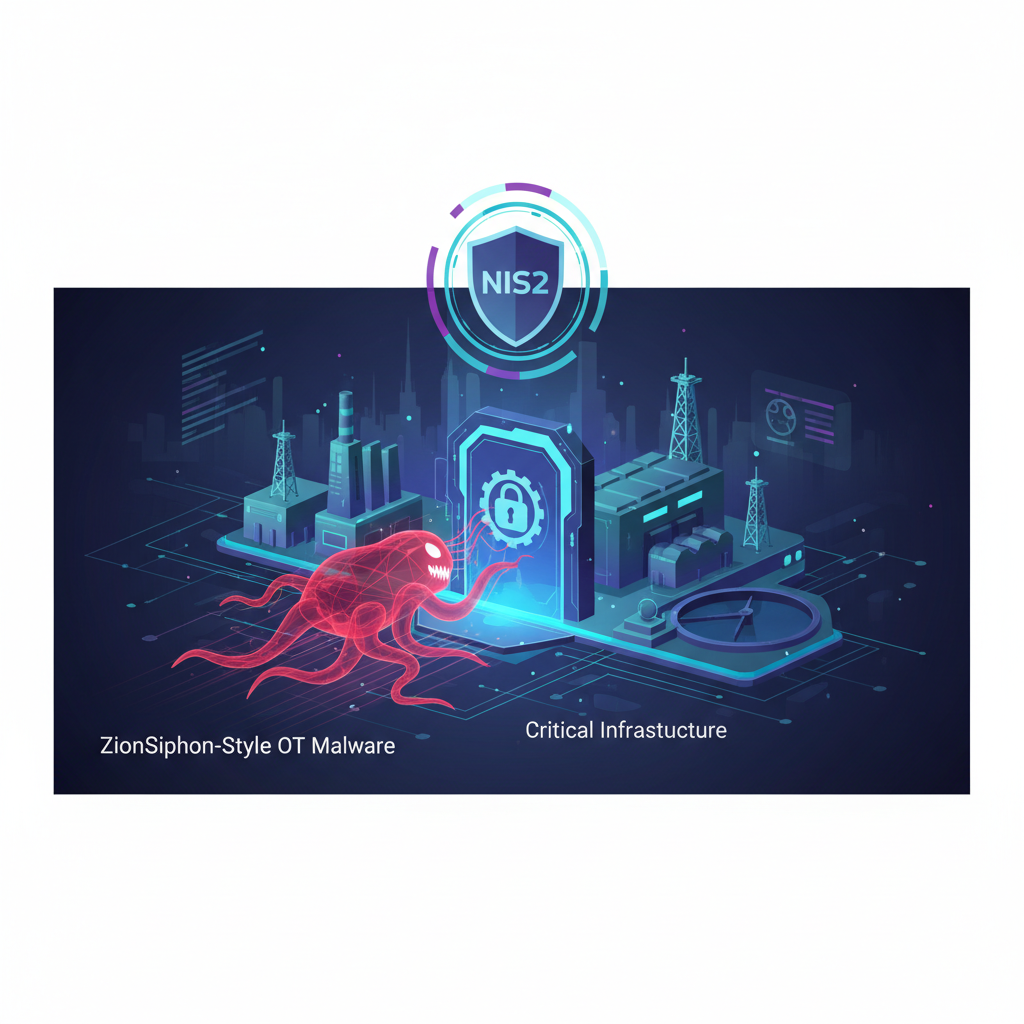
NIS2 and Critical Infrastructure: What ZionSiphon-Style OT Malware Means for Your Compliance Obligations
The emergence of sophisticated operational technology (OT) malware like ZionSiphon has sent shockwaves through the critical infrastructure security community. As organizations scramble to understand the technical implications of these advanced threats, a parallel challenge is unfolding in boardrooms and compliance departments across Europe: how do attacks of this nature affect obligations under the Network and Information Systems Directive 2 (NIS2)? The answer is both complex and urgent.
NIS2, which came into force across EU member states in October 2024, significantly expanded the scope and depth of cybersecurity requirements for entities operating critical infrastructure. When OT-targeting malware capable of manipulating industrial control systems enters the picture, the compliance stakes rise dramatically. Understanding the intersection of these two realities is no longer optional — it is a fundamental business and legal necessity.
Understanding ZionSiphon-Style OT Malware
Before diving into compliance implications, it is essential to understand what makes ZionSiphon-style malware so uniquely dangerous in the context of critical infrastructure. Unlike traditional IT-focused cyberattacks, OT malware is specifically engineered to interfere with the physical processes that underpin society's most vital systems — energy grids, water treatment facilities, transportation networks, and manufacturing plants.
Key Characteristics of Advanced OT Malware
- Protocol-aware functionality: ZionSiphon-style malware understands and manipulates industrial communication protocols such as Modbus, DNP3, and IEC 61850, allowing it to blend in with legitimate traffic while causing operational disruptions.
- Lateral movement between IT and OT environments: These threats are designed to traverse the traditionally assumed air gap between corporate IT networks and operational technology systems.
- Persistence and stealth: Advanced OT malware often lies dormant for extended periods, gathering intelligence before executing its payload, making detection and attribution significantly more difficult.
- Physical consequence design: Unlike ransomware targeting data, ZionSiphon-style malware aims to cause tangible physical harm — equipment damage, production halts, or even safety incidents.
- Supply chain vectors: Many of these threats exploit trusted third-party vendor connections, bypassing perimeter defenses entirely.
NIS2's Expanded Scope: Are You Covered?
One of the most significant changes introduced by NIS2 compared to its predecessor is the dramatic expansion of which organizations fall under its regulatory umbrella. The directive now distinguishes between Essential Entities (EEs) and Important Entities (IEs), each subject to different levels of supervisory scrutiny but both bound by substantive security obligations.
Sectors Newly Brought Under NIS2
- Energy (electricity, oil, gas, hydrogen)
- Transport (air, rail, road, water)
- Banking and financial market infrastructure
- Health, including medical device manufacturers
- Drinking water and wastewater
- Digital infrastructure and ICT service management
- Public administration
- Space
- Postal and courier services
- Waste management
- Manufacturing of critical products (chemicals, food, medical devices)
If your organization operates within any of these sectors and meets the size thresholds — generally medium-sized enterprises with 50 or more employees or €10 million in annual turnover — NIS2 almost certainly applies to you. The emergence of OT-targeting threats like ZionSiphon makes the question of compliance not merely academic but existentially important.
Core NIS2 Obligations Triggered by OT Threats
ZionSiphon-style attacks trigger multiple layers of NIS2 obligations simultaneously. Understanding which specific requirements are implicated — and how — is critical for compliance teams and CISOs alike.
1. Risk Management Measures (Article 21)
Article 21 of NIS2 mandates that covered entities implement appropriate and proportionate technical, operational, and organizational measures to manage cybersecurity risks. In the context of OT malware, this translates to several concrete requirements:
- OT-specific risk assessments: Generic IT-focused risk assessments are no longer sufficient. Organizations must conduct dedicated assessments of their operational technology environments, accounting for the specific threat vectors used by malware like ZionSiphon.
- Network segmentation: Proper segregation between IT and OT networks must be documented, implemented, and regularly tested. Assumed air gaps that exist only on paper will not satisfy regulators.
- Supply chain security: Given that many OT attacks leverage third-party vendor access, NIS2 explicitly requires organizations to assess and manage cybersecurity risks in their supply chains.
- Cryptographic policies: Where applicable to OT environments, the use of encryption and secure communications must be evaluated and implemented.
2. Incident Reporting Obligations (Article 23)
Perhaps the most operationally demanding aspect of NIS2 in the context of an OT malware incident is the mandatory incident reporting timeline. The directive establishes a tiered reporting framework that leaves little room for delay:
- Early warning within 24 hours: Organizations must notify the relevant national Computer Security Incident Response Team (CSIRT) or competent authority within 24 hours of becoming aware of a significant incident, even if full details are not yet available.
- Incident notification within 72 hours: A more detailed notification must follow within 72 hours, including an initial assessment of severity and likely impact.
- Final report within one month: A comprehensive final report must be submitted within a month, detailing root cause analysis, remediation measures taken, and cross-border impacts if any.
For OT malware incidents, this timeline is particularly challenging. The stealthy nature of ZionSiphon-style threats means that organizations may not realize an attack has occurred until significant damage is already done. The clock starts ticking from the moment of awareness, not from the moment of initial infection, but rapidly assembling accurate technical information in an OT environment under stress is a significant operational challenge.
3. Business Continuity and Crisis Management
NIS2 requires essential and important entities to have robust business continuity plans that specifically account for severe cybersecurity incidents. Given that ZionSiphon-style OT malware can directly impair physical operations — shutting down production lines, disrupting utility services, or compromising safety systems — this requirement takes on an especially critical dimension.
Compliance teams should ensure that continuity plans address:
- Manual override and analog fallback procedures for critical operational processes
- Communication protocols for regulatory notification alongside operational recovery
- Coordination with national authorities and sector-specific regulators during OT incidents
- Recovery time objectives (RTOs) that account for the unique complexities of restoring OT environments safely
The Supervisory and Enforcement Reality
NIS2 introduces a significantly strengthened enforcement regime compared to its predecessor. Competent authorities now have broad supervisory powers, including the ability to conduct on-site inspections, demand security audits, and issue binding instructions. For Essential Entities, this includes proactive supervision — meaning regulators don't need to wait for an incident to begin scrutinizing your security posture.
The financial penalties for non-compliance are severe. Essential Entities face fines of up to €10 million or 2% of global annual turnover, whichever is higher. Important Entities face fines up to €7 million or 1.4% of global turnover. Beyond financial penalties, senior management — including boards of directors — can be held personally accountable for systemic compliance failures. This represents a fundamental shift in how cybersecurity governance is treated at the executive level.
Practical Steps for OT-Focused NIS2 Compliance
Given the dual threat of sophisticated OT malware and a demanding regulatory framework, organizations must take a proactive and integrated approach to compliance. The following steps represent a practical roadmap:
Conduct a Comprehensive OT Asset Inventory
You cannot protect or report on what you cannot see. A complete, up-to-date inventory of all OT assets — including firmware versions, vendor details, and network connectivity — is the foundational first step. Many organizations are surprised to discover the extent of their OT exposure during this process.
Implement OT-Specific Threat Detection
Traditional IT security tools are largely blind to OT environments. Deploying purpose-built OT monitoring solutions capable of detecting anomalous behavior in industrial protocols is essential. These tools provide the visibility needed both to detect ZionSiphon-style threats early and to generate the evidence required for regulatory reporting.
Develop and Test an OT Incident Response Plan
An incident response plan that does not explicitly cover OT scenarios will fail at the worst possible moment. Organizations should develop detailed playbooks for OT malware scenarios, including the specific steps required to meet NIS2's 24-hour and 72-hour notification windows while simultaneously managing operational disruption.
Engage Legal and Regulatory Counsel Early
The intersection of technical incident response and regulatory compliance is complex. Having legal counsel familiar with NIS2 engaged before an incident occurs ensures that notification decisions are made with full awareness of legal implications, including considerations around cross-border reporting where operations span multiple EU member states.
Conduct Regular Security Assessments and Penetration Testing
NIS2 implicitly requires that organizations continuously validate the effectiveness of their security measures. Regular OT-focused penetration testing and red team exercises that simulate ZionSiphon-style attack vectors help identify gaps before threat actors do — and generate the audit trail that demonstrates due diligence to regulators.
The Bigger Picture: NIS2 as a Security Catalyst
It would be a mistake to view NIS2 compliance purely as a box-ticking exercise. The directive's requirements — when properly implemented — genuinely improve an organization's resilience against exactly the kind of sophisticated OT threats that ZionSiphon represents. The regulatory push toward documented risk management, supply chain security, and rapid incident response aligns closely with security best practices that the OT security community has long advocated.
The threat landscape is not standing still. Threat actors targeting critical infrastructure are becoming more sophisticated, more patient, and more capable of causing real-world harm through OT compromise. NIS2 exists, in part, precisely because of this escalating threat environment. Organizations that embrace the directive's requirements as a genuine security framework — rather than a compliance burden — will be better positioned to detect, contain, and recover from the next ZionSiphon-style campaign.
Conclusion
The convergence of advanced OT malware like ZionSiphon and the rigorous demands of NIS2 creates a complex but navigable challenge for critical infrastructure operators. The key lies in recognizing that compliance and security are not separate workstreams — they are deeply interdependent. Meeting NIS2's requirements demands the kind of genuine operational technology security investment that also happens to be the most effective defense against the OT threats that keep security professionals awake at night.
Organizations that act decisively now — building OT visibility, implementing robust incident response capabilities, and embedding NIS2 obligations into their security governance frameworks — will not only avoid the significant financial and reputational consequences of non-compliance but will also be meaningfully better protected against the evolving threat landscape that ZionSiphon-style malware represents.